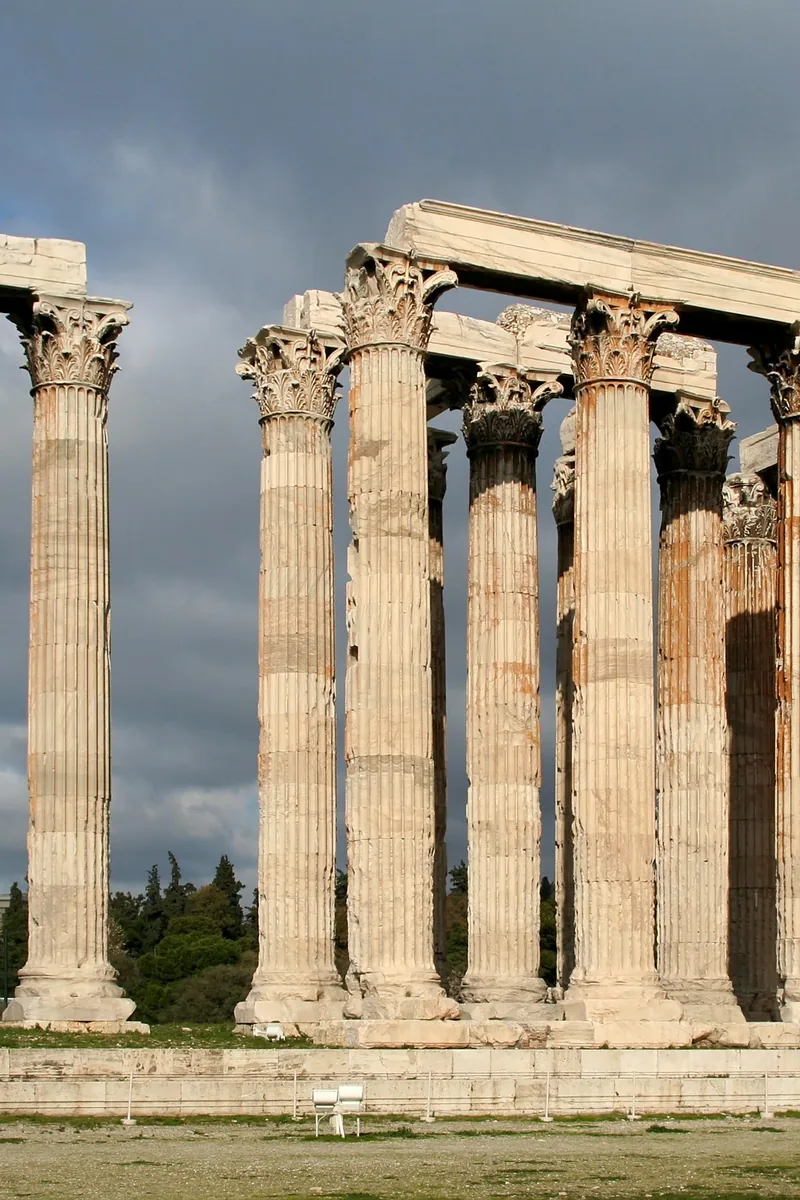
The Temple of Olympian Zeus, known in Greek as the Olympieion, was the largest temple in Greece and one of the largest ever built anywhere in the ancient world — a colossal sanctuary raised to Zeus, king of the gods, in the heart of Athens. It was begun in the 6th century BC under the tyrant Peisistratos and his sons, who planned it on a titanic scale to rival the greatest temples of the Greek east. That ambition outran the city's resources, and after the fall of the tyranny the vast building was left standing unfinished for centuries, a famous monument to overreach even in antiquity. It rises today only a short walk southeast of the Acropolis, between the Plaka and the National Garden.
The temple's story turns on the Roman emperor Hadrian. Nearly 640 years after it was begun, Hadrian, a devoted philhellene, finally completed and dedicated the temple in 131 AD, crowning it with a giant gold-and-ivory statue of Zeus in the old chryselephantine manner — and placing a colossal statue of himself alongside the god. In its finished form the temple carried 104 colossal Corinthian columns, each around seventeen metres tall, ranged in a vast forest of stone. Today fifteen of them still stand, joined together at the top by their entablature, while a sixteenth lies broken across the ground exactly where it fell during a storm in 1852, its great drums scattered like a stack of giant coins.
The Olympieion stands in the centre of modern Athens, ringed by the city yet set apart in its own open archaeological ground, with the Acropolis rising to the northwest and the greenery of the National Garden close by. Beside the site stands Hadrian's Arch, the monumental gateway that once marked the boundary between the old city of Theseus and the new city of Hadrian, free to admire from the street. The ground is open and largely unshaded, so early-morning or late-afternoon hourly slots are far kinder than the middle of the day. Because entry is timed by the hour, we handle the ticketing in your own language and reserve the slot you want, so you can give your attention to the columns instead of the queue.